

24 Nov
The global data center boom, fueled by the generous budgets of hyperscalers and major investors, is steadily pushing construction costs upward. Analyses show that developers are already facing the challenge of working with a “final price” that is impossible to fix from the start. Estimating data centers budgets is becoming increasingly difficult as material prices fluctuate, critical equipment has delivery times exceeding a year, new technologies entail additional costs, and every project stage involves financial risks.
In early November, Turner & Townsend published the Data Centre Construction Cost Index 2025-2026, providing a clear view of the market’s actual state. This is currently the only index exclusively dedicated to data center construction costs, making it an essential reference for investors, developers, and operators. Its analysis helps us understand the directions the market is heading and the implications for future projects.
Liquid Cooling vs. Traditional Data Centers: Understanding the Cost Gap
According to the Turner & Townsend report, costs are rising, and the transition to liquid cooling systems involves significantly higher expenses compared to traditional (air-cooled) data centers. In numbers, the reality looks like this: construction costs for traditional cloud data centers increased by 5.5% in 2025 compared to last year. However, this growth is moderate compared to the 9% jump reported in 2024, indicating that the market is beginning to stabilize. The average construction sector inflation of 4.2% is felt less acutely in the data center segment as local supply chains develop, easing price pressures.
The situation is different for data centers using liquid cooling systems designed for AI workloads. In the U.S., construction costs for these facilities are, on average, 7–10% higher than those of traditional data centers with the same IT capacity. These high-density centers are more complex to build, integrate significantly more expensive technical and cooling systems, and see rapidly increasing demand in markets such as the U.S., the U.K., Europe, and East Asia, as companies seek to support increasingly intensive AI workloads.
Density Pays Off in the Long Run
The same Turner & Townsend report shows that, precisely because of their density, AI data centers can be a more cost-effective choice in the long term. They often feature more flexible designs, which can reduce project costs. Additionally, higher density allows for a smaller building footprint, and “mega campuses” designed to run AI models across multiple interconnected buildings bring significant economies of scale.
On the other hand, traditional cloud data centers require complex measures to ensure service continuity (technical redundancy measures), which considerably increase construction costs and, in the long term, operational expenses as well.
Developers’ Insights
How do developers view the 2025 situation? Nearly half of respondents reported construction cost increases of 6–15%, while 21% say costs have risen more than 15%. Additionally, under inflationary pressure, the majority (60%) anticipate further increases of 5–15% in 2026. About 21% are even more pessimistic, expecting inflation to exceed 15% in the coming year.
Major European capitals are climbing the ranks in data center construction costs, approaching the levels of large U.S. cities. Paris and Amsterdam reach $10.8 per watt, comparable to Portland, while Madrid and Dublin surpass U.S. cities such as Atlanta, Phoenix, and Columbus.

Check out the full Turner & Townsend report here.
Future-Proof Data Centers: Hybrid Designs for AI and Cloud Workloads
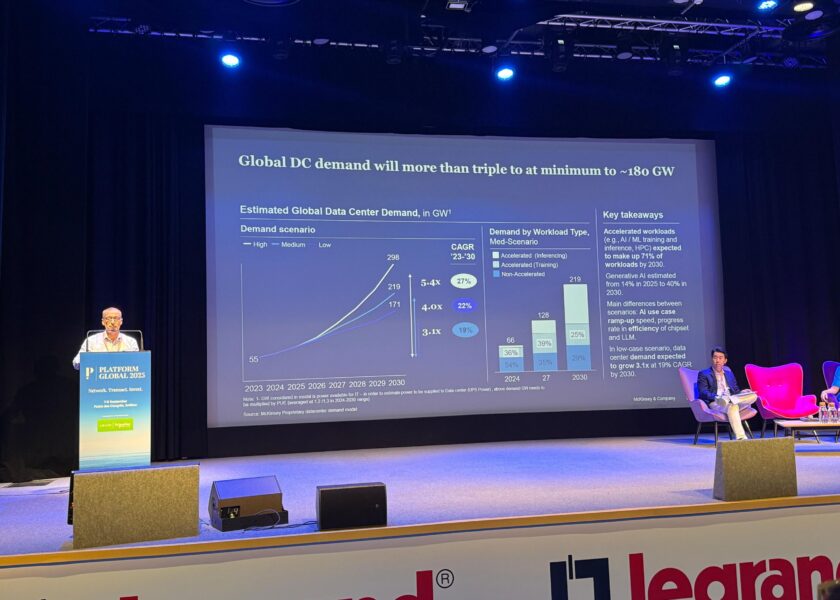
According to McKinsey, while AI training currently drives the size and scale of data centers, future facilities will be hybrid, combining training workloads, inference tasks, and cloud operations. These centers could surpass in size even the facilities considered large just two years ago.
Today, the time between requesting services and starting construction of a data center can range from 12 to 36 months, depending on type, design, size, and location. Optimizing the construction process can significantly shorten these timelines: for example, a U.S. architecture firm completed the design of a 929 m² data center in Colorado in just 30 days, using an Agentic AI platform – the first project of its kind entirely designed by artificial intelligence.
Such innovations could reduce construction time by 10–20% and deliver similar capital savings, potentially cutting global projected expenditures of $1.7 trillion by 2030 by up to $250 billion, according to McKinsey analysts.
They also recommend several key directions that could transform how data centers are designed and built, including:
- Designs should allow for phased expansion, modularization, and off-site assembly.
- Prefabricated and modular solutions currently account for 40–60% of data center components, with some projects using up to 80–85%. These solutions accelerate construction, reduce on-site labor, and improve quality.
- Generative scheduling tools allow simulation of thousands of scenarios to optimize resources and work sequences, reducing delivery time by up to 20%.
Discover more in McKinsey’s full analysis.
In short, the data centers of tomorrow will get more expensive unless builders embrace innovative technologies and scalable, modular designs. These approaches help developers cut costs, accelerate delivery, and handle complexity more effectively, ensuring the infrastructure is ready for the rising demands of AI and cloud workloads.